



The Lunar New Year Festival allowed students to celebrate the incredible artistry, community and traditions of the start of the Chinese New Year.
On Jan. 30, a spectacular cultural convening occurred in celebration of Lunar New Year. From 7-10 p.m., students gathered in Covel Grand Horizon to enjoy the remarkable artistry, community and traditions of the beginning of the Chinese New Year, a holiday celebrated by a vast number of countries, including Malaysia, Vietnam and more.
Otherwise known as the Spring Festival, the two-week celebration begins Feb. 17 and lasts 15 days. It is based on the historical lunisolar calendar, where dates are determined by the sun and moon, and has been a tradition for over 3,000 years.
As I walked up the steps, a rendition of drumming reverberated through my chest. The room was packed with students. The laughter, music and dance was practically visible in the air. Students gathered around tables with numerous activities, such as informational and traditional cultural presentations, origami and white snake scale drawings. One table also held pamphlets explaining the various types of instruments utilized in Chinese traditional music and dance. A long line gathered in anticipation for food, including fried rice, chow mein, Monster energy drinks and more.
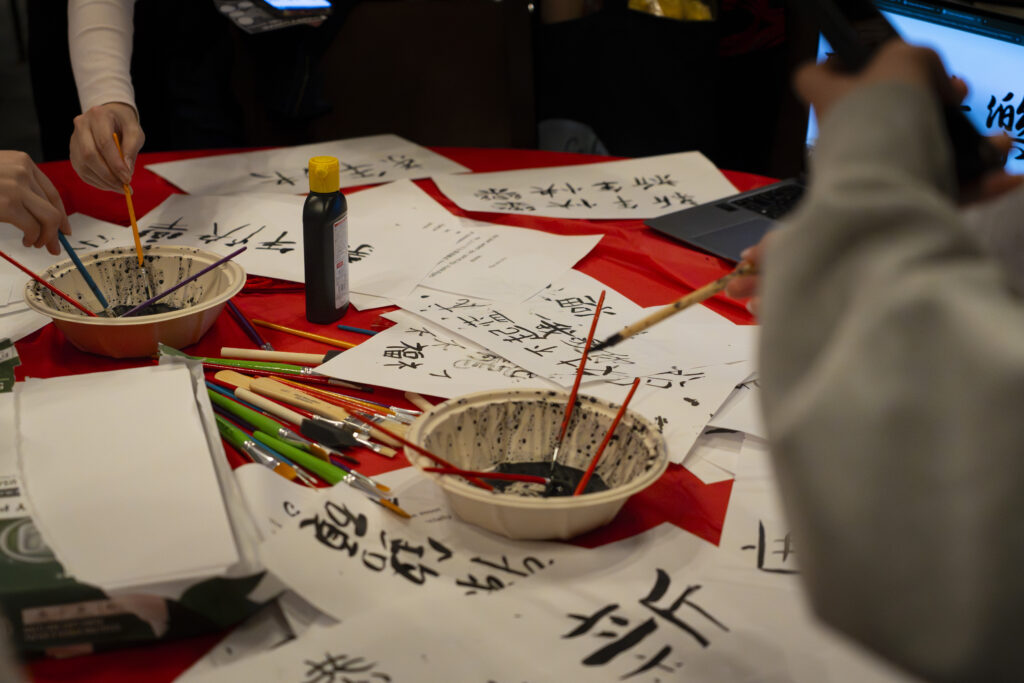
Sophia Tan, a second-year design media arts and cognitive science student, led a calligraphy writing station as a part of the Association of Chinese Americans, also called ACA. Students crowded around to “try out writing in a Chinese traditional way,” said Tan. She grew up in Taiwan, and calligraphy allows her to connect with her culture. Calligraphy is a way in which she “reminices of [her] childhood, sharing [her] culture with others.”
Various clubs, including the Teochew Association, held their own interactive matching games. Teochew is a region located in the eastern Guangdong province of China. Cards with depictions of various traditional foods, such as red peach cake, taro pudding, daikon cake and bean curd sausage, were assorted and explored the traditional cuisine of the Teochew culture.
Many more clubs were represented at the event, like the Association of Indonesian Americans, the Hong Kong Student Association, the Singapore Students Association and more.
Drifting center stage, several performances ensued. The Jade Lotus Lion Dance, UCLA Wushu traditional martial arts, and Kyodo Taiko or Japanese drumming ensemble impressed audiences.
In particular, SEOULA, a Los Angeles-based K-Pop cover team, made a statement on Friday night. Aaron Vu, a fourth-year film and television student, explained that the performance consisted of three songs, “Little Miss” by GIRLSET, “Rizz” by Xlov and “Jump” by Black Pink. GIRLSET is a global girl group under a K-Pop company, and the K-Pop group Xlov is known for breaking standards and being more openly queer. Their final song, “Jump” by Black Pink, was a more recent comeback song after the group had two to three years of no group singles, “so it was an explosive dance, it’s fun.”
The audience was in agreement, to say the least. From the second they took the stage, SEOULA left the audience cheering in excitement as the K-Pop group showed off their ferocious confidence. The intensely fun choreography elicited lots of energy from the crowd.
“When it came to choreographing [Jump], it’s just about the way I feel when I listen to these songs. As a choreographer when I listen to songs, moves will appear in my head too, and so bringing that to life is super cool…Choreography is so important because it brings out the energy and the life in the songs.”
Vu also said, “Dancing has always been a way for me to be extremely expressive about my own personality. I almost put on a character…something I can pour my energy into to showcase who I really am to audiences.”
Vu added, “Performing on a stage, especially for a Lunar New Year event, was so important because culturally, as an Asian American, I’m Vietnamese specifically, we get to celebrate one of the biggest events for Asian people.”
SEOULA’s Lunar New Year performance was just one glimpse into the various types of boy, girl and hip hop groups they cover. The club meets every Sunday from 7-9 p.m., bringing in choreographers to teach workshops. “We specialize in energy, performance, and character. It’s not just about dancing.”
Vu also mentioned K-Pop roots from other cultures, including African American hip hop. He said, “K-Pop origins do root from cultures that are outside the Korean country. And I think it’s very important to credit Black Americans specifically for how much it’s influenced K-pop.” Check out SEOULA on Instagram @seoulaofficial and on Youtube.
The Lunar New Year event blended tradition and anticipation, from the Lion Dance and calligraphy to K-pop covers that shook the room. The result was a joyful, high-energy welcome to the year ahead.
__
Featured Image Photographed by Janwayne Orme/BruinLife
