


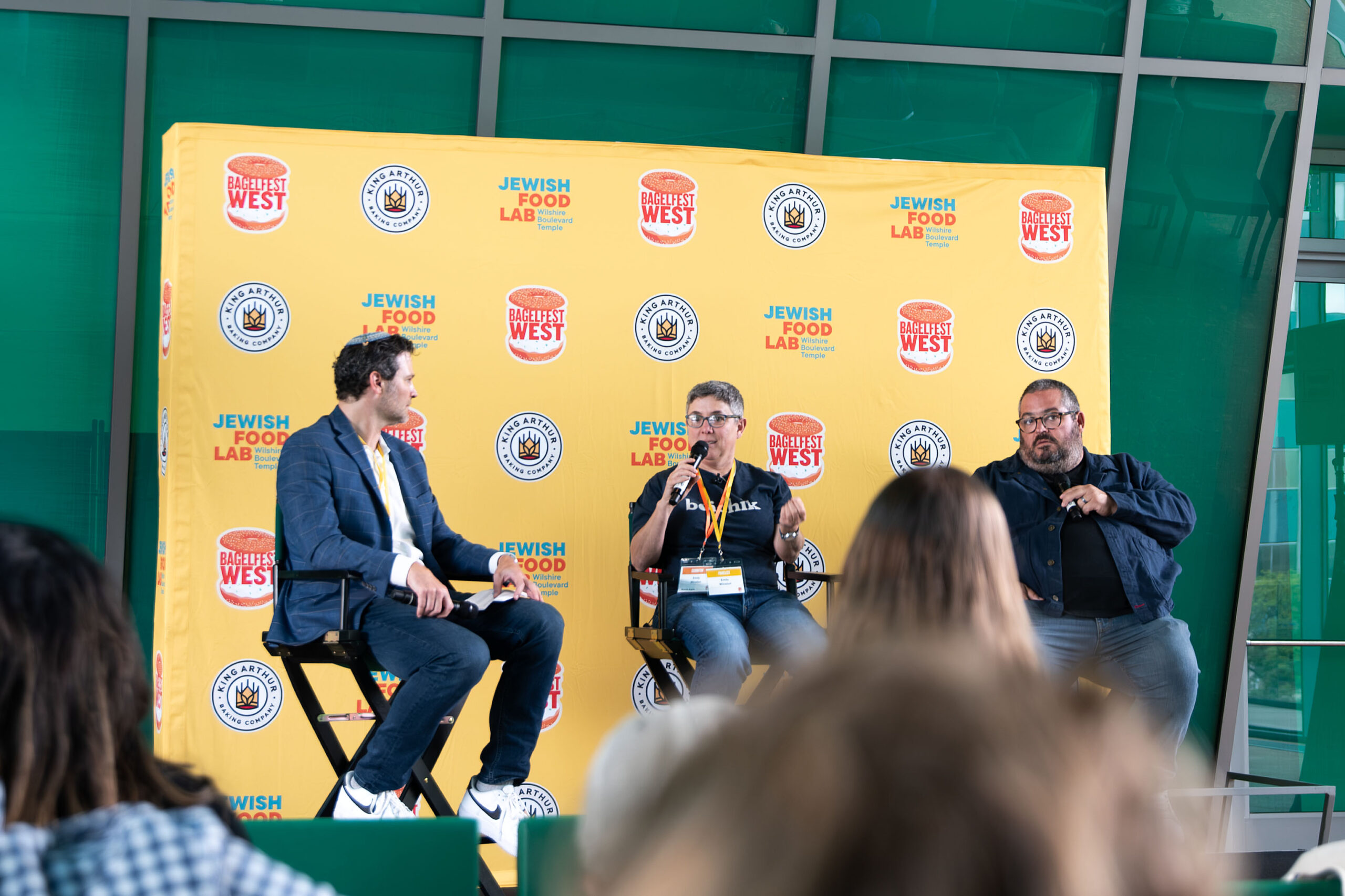
Bagels have been dirtied in California for many, MANY years. But those days are no more! For the rolling out of the first BagelFest West in 2026 showcased the diaspora of this beloved breakfast item from San Diego to Seattle. With California practically reinventing the wheel amidst the Bagel Renaissance, Emily Winston of Boichik Bagels and chef Eric Greenspan of the soon-to-open Mish Deli, sat down with Senior Rabbi Joel Nickerson at Wilshire Boulevard Temple to define, “What is a California-style bagel?”
Both raised on the East Coast, Winston and Greenspan grew up in a traditional New York-style bagel culture, with Winston citing H&H Bagels as her family’s go-to. However, after she moved to California’s Bay Area and discovered a lack of good bagels as well as her hometown hookup shutting down due to tax fraud, Winston took the next five years to craft an ode to the Mets and make New York bagels for the West Coast.
Greenspan, on the other hand, started making bagels three months ago for his newest restaurant, Mish, where his crash course took place at 1 a.m. in Montreal at St-Viateur Bagel. On if there is a definitive Los Angeles style bagel or if it’s still evolving, Greenspan jumped in by saying that a California bagel will always be evolving, saying, “it’s not the water, it’s tradition,” and back east, they have a 100-year head start.
Unique to LA, however, Greenspan and Winston both brought up the prominence of a chef-driven, not Bubbie-driven, artisanal approach to bagels, something bakers cannot do in NY, with Mish restaurateur pointing out the West Coast’s experimentation with fermentation, open-faced sandwiches and a persnickety use of tweezers in their presentation. Interestingly, Greenspan pointed out that Apollo Bagels in Manhattan, notably one of the best bagels on the island, is in fact a California-style bagel. He then made a joke about how in 50 years, Yankees will complain about their dense Brooklyn water bagels.
However, with all the diversity across LA’s bagel scene, Winston, who makes a roll akin to that of the Empire State, noted that she has to make herself known as such in order to not be compared with other bagel types, the likes of stuffed or sourdough varieties.
On the topic, Nickerson inquired about what makes a sourdough bagel standout. Winston summed it up to the dough being made from a sourdough starter as opposed to commercial yeast, and sourdough bagels needing a longer — at least 24 hour — fermentation process, whereas commercial bagels, think Sarah Lee, do not. But on the increase in popularity of this particular variety, Greenspan questioned whether “bagel purists” would accept it as a bagel, given that its preparation is dramatically different. Greenspan pointed to Courage Bagels and Mustard’s Bagels as prime examples of this quandary, despite them both being delicious, the chef said.
Diverging from the fermentation process to add flavors to the dough, Greenspan brought up the untapped potential of the boiling process. A New York bagel will use barley malt syrup for color and flavoring, a Montreal-style uses a honey-water boil to add a delicate crust and some sweetness, but Greenspan goes all in, not only utilizing a honey boil, but throwing in star anise, black pepper corns, garlic and salt into the pot during his bagel’s two-minute boil. For those who have never boiled dough before, two minutes is a long time.
Since another defining characteristic of a California bagel is the aesthetics, Nickerson asked the panelists their thoughts on social media’s effect on how bagels are perceived. Winston said that while she sees the practicality of the sandwich style in the context of a Manhattan subway, opening bagels up “can be pretty,” a preference definitely pushed by Instagram, the baker said.
Greenspan took this one step further by expanding on the sensuality of the bagel; seeing it first, then smelling it, touching, hearing the crunch and lastly, tasting the dish. He then went on, saying that this is a detriment to the food, essentially decorating it to be pretty, not because it tastes good, even listing the rainbow bagel trend as a visual.
When the floor opened up, questions from the audience revealed some fresh-out-the-oven takes on LA’s bagel trends. Rip and dip style isn’t a go-to form of consumption with either baker, with Winston saying it leans too much into pretzel territory. And when it comes to stuffed bagels, Greenspan said he hopes they are, “just a fad,” with Winston in agreement.
While long sourdough fermentations, lively produce and sensual aesthetics are prominent with California’s bagels at the moment, the panel ended with two lasting remarks from Greenspan and Winston: 1) lox should never go on a cinnamon raisin bagel and 2) the illusive “California-style” bagel is still … on the rise.
