



Over my many years of being a student, I have tried numerous note-taking techniques. In high school, I primarily took notes on pen and paper or typed my notes on my laptop. Before coming to college, I invested in an iPad, and now I take a majority of my notes on this device. I’ve found that there are benefits to all of these methods of note-taking, and here, I will explore them.
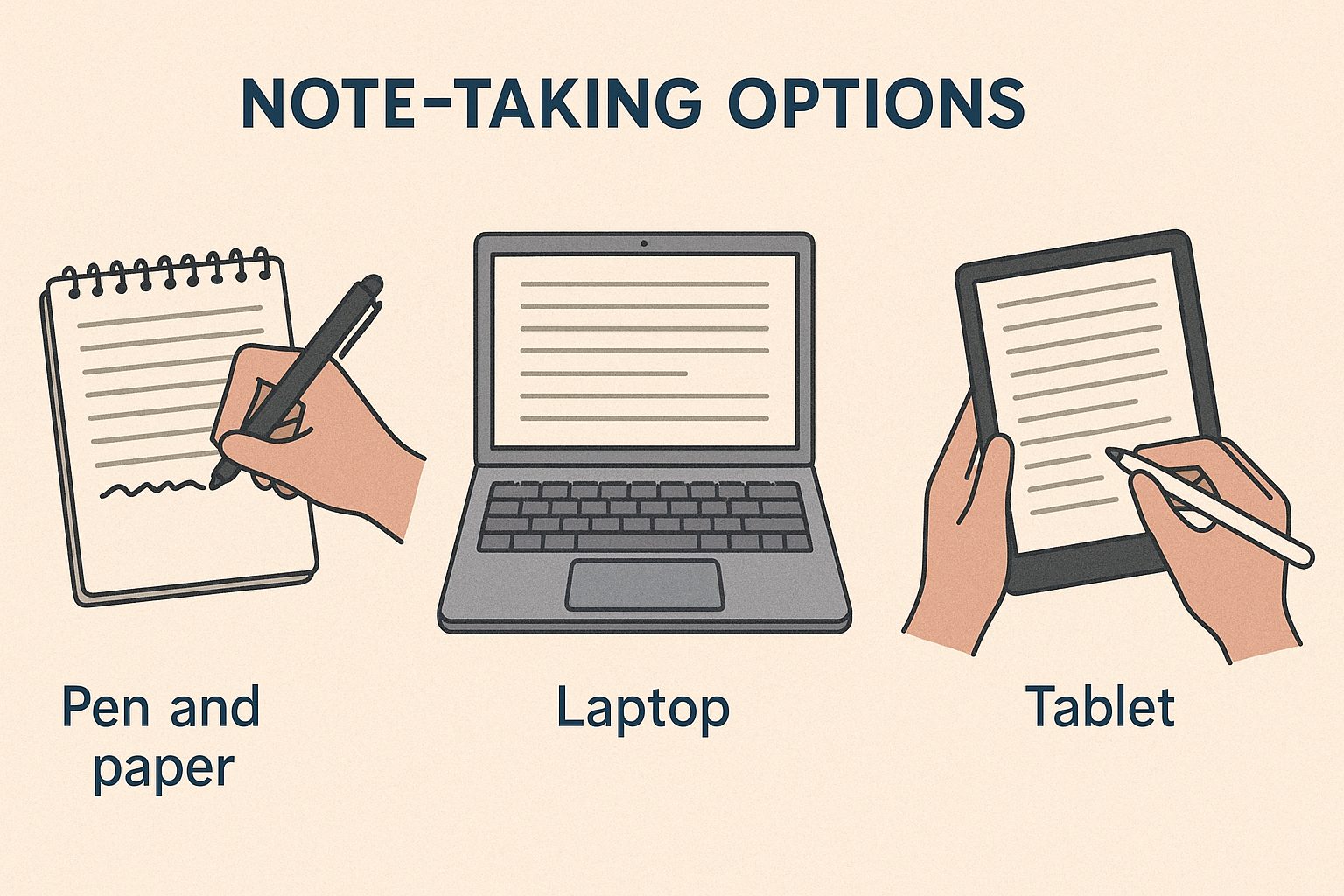
Illustration generated using ChatGPT
Handwriting notes on a tablet
In the past few months of my college career, I have found that handwriting notes on my iPad has been indispensable to my success in courses. Instead of hauling around multiple notebooks for each of the courses I am enrolled in, I am able to have multiple digital notebooks that are contained on a single device. This has been a lifesaver for my back and shoulders as I walk to and from my classes on the large and hilly campus.
Additionally, taking notes on an iPad allows me to gain the memorization benefits of handwriting while also ensuring all of my notes are organized and automatically saved. This means there is no chance of me forgetting or misplacing my notes — all I need to do is bring my iPad with me.
As someone who has large and loopy handwriting, I find this note-taking technique to be extremely useful as I can zoom in and out of the paper I am writing on – ensuring that my notes are neat and easy to read. Additionally, I find it very helpful to be able to copy and paste, change font size and alternate the colors and pen styles of my handwriting with a simple tap.
Furthermore, there are multiple apps you can download to write down and organize your notes. I am an avid Goodnotes user, and I believe this app is versatile for each of my courses. This app enables me to create numerous folders for each quarter of coursework I am enrolled in, and it even has an artificial intelligence tool integrated into the app.
I find that the most practical use of note-taking on an iPad is the ability to import and write directly on lecture slides. This allows me to pay attention to my professors’ lectures, as I know that I do not need to copy each word down from the lecture slides.
Pen and paper
As a tried-and-true technique of taking notes, writing on paper with a pen or pencil is one of the more common methods of note-taking – and for a good reason. Handwriting in a notebook is a great way to keep your notes organized while also gaining the same memorization benefits as stated above with the tablet technique.
This spring quarter, two of my courses require that students do not use technology in class, so I handwrite all of my notes for these classes in a notebook. While I find my bag to be heavier and more unwieldy now that I have to carry notebooks with me around campus, I have also noticed that I am able to focus better in class without the distraction of technology.
Similarly to handwriting notes on a tablet, being able to jot down information quickly in a notebook has been crucial in courses that require math calculations. With a pencil or pen, it is easy to erase or cross out your mistakes, and you can use an iPad or tablet the same way.
Typing notes on a laptop
Typing your notes is another effective method of note-taking. I find typing my notes to be most efficient and effective in my courses that cover a lot of content in each lecture. When the professor speaks quickly and it feels like there is a great deal of content to take note of, typing allows me to write down important information quicker than writing by hand.
Additionally, typing notes on a laptop is easy since most students (including me) carry around a laptop everywhere they go around campus, so they likely have their laptop on hand. This means you won’t need to carry additional notebooks in your bag, making it easier for you to walk around campus.
Overall, I find that each of these note-taking techniques is best for different types of courses. While you may be more comfortable using certain techniques over others, I recommend giving all of these methods a try to discover what works best for you.
—
Featured Image via Adobe Stock
